THE SITE
First discovered in the 1980s under land used for agricultural production, the site of Coriglia is home to an Etrusco-Roman settlement located 10 km northwest of the city of Orvieto, in the Umbria region of Central Italy. For nearly two decades, excavations at Coriglia have uncovered a complex assemblage of monumental structures that resulted from the persistent habitation of the site for over 1,000 years. The major occupation of Coriglia began with an Etruscan phase (ca. 7th century BCE) and reached its peak during the Roman Imperial period, though the site continued to be inhabited until the early Renaissance era.
The major features of the site include two large terraces, Etruscan and Roman habitation, bath complexes, water storage facilities, and a road, among several other monumental structures. The presence of several water management facilities like the two bath complexes suggest that water was moved and stored on a large scale at Coriglia, in part due to natural springs (hot and cold) formerly located on site. Structures such as a large subterranean barrel vaulted storage area likely supported the baths and surrounding architecture, and the continued presence of a central road indicates movement between the terraces over several hundred years. Evidence of continual habitation is indicated by the presence of Greek, Etruscan, Roman, and Medieval ceramics, marble revetment, architectural terracottas, small metal objects, fresco fragments, and mosaics. Most recently, an Etruscan-era kiln was discovered on site.
Current stratigraphic and archaeological evidence suggest the site functioned as a mansio, or rest area along major roads used by government officials and other important travelers, from the 2nd through 4th centuries CE. After this period, Coriglia was used as late antique site to process and recycle materials such as marble (for lime), ceramics, and glass. By the early Renaissance Coriglia took on a new agricultural function for growing olives trees and grape vines.
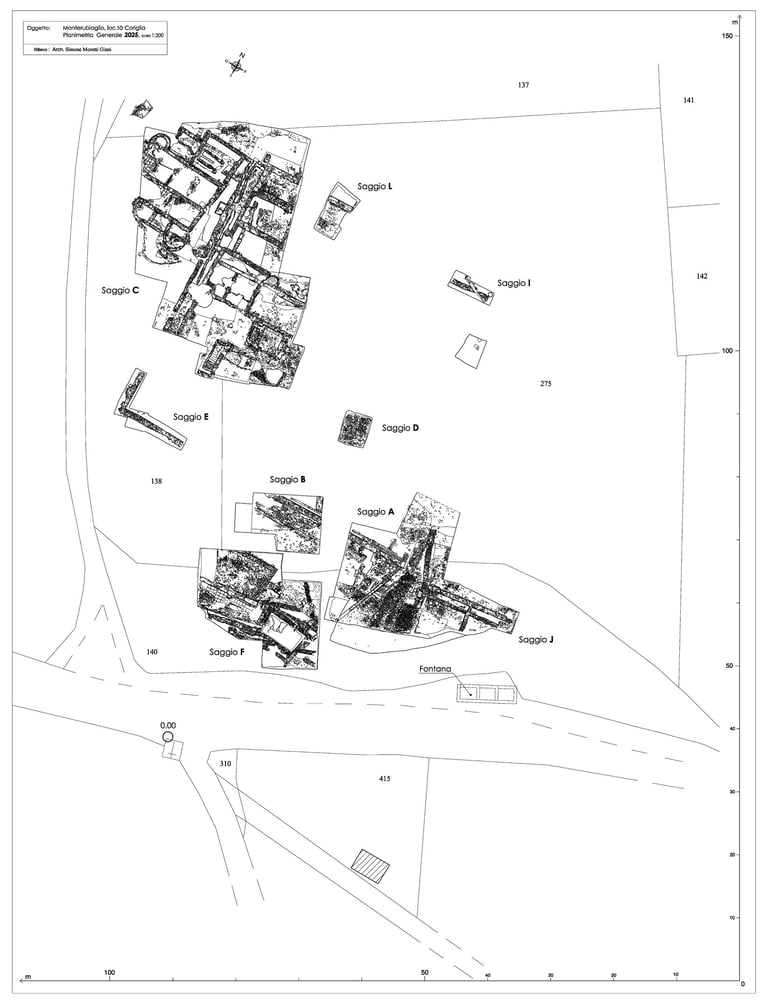
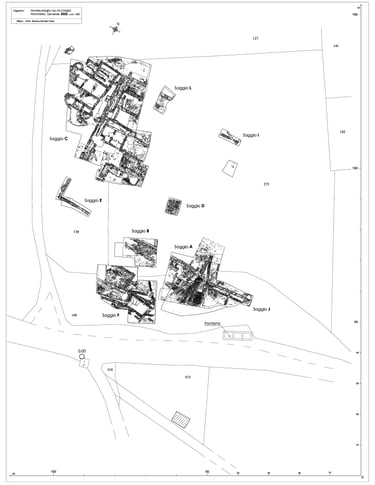
Simone Moretti Giani (2025)
Location
Our site lies below the town of Monterubiaglio, nestled in the rolling hills of Umbria, Italy.